

What is Windows PowerShell? Features and benefits of upgrading
Windows ten ships with Windows PowerShell 5.0; the latest version now being PowerShell vii.0. Windows eight.1 comes installed with Windows PowerShell 4.0. The new version hosts many new features designed to brand its language simpler, easier to use, and to avoid mutual errors. If you are using an earlier version of PowerShell on your Windows operating system, migrating to this version of Windows PowerShell volition bring many benefits. It not but lets the system administrators manage every aspect of Windows Server Os, but likewise offers control over SQL, Exchange and Lync-based servers.
What is PowerShell
PowerShell is a command-line shell and a scripting language. You tin use PowerShell for script automation, run batches of commands, control resource in the Cloud, etc. Nowadays there's PowerShell Core which works on Linux, macOS, and Windows Os.
If yous need more information, you lot can check out Introduction to PowerShell on microsoft.com for some great learning.
Which version of PowerShell I am running
To find out which version of PowerShell yous are using, do the following.
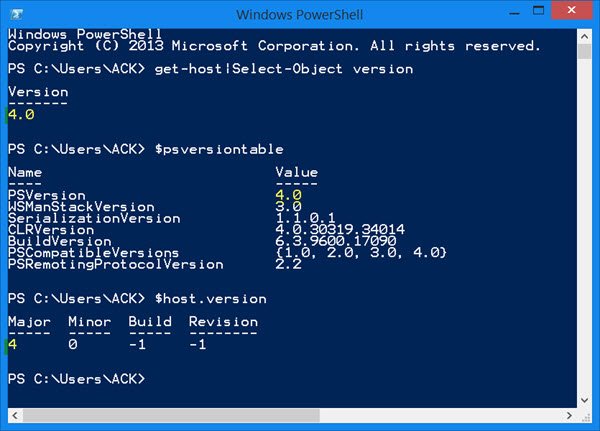
Open up a PowerShell window and blazon any i of the following commands and hit Enter:
go-host|Select-Object version $psversiontable $host.version
For more on this read – How to bank check PowerShell version in Windows x.
- Windows Server 2022, Windows Server 2008 R2, Windows Server 2008 SP2, Windows 8 and Windows 7 with SP1 users will be able to utilise Windows PowerShell 3.0.
- Windows Server 2022 R2, Windows Server 2022, Windows Server 2008 R2, Windows viii.1 and Windows 7 with SP1 users will exist able to use Windows PowerShell four.0.
- Windows 10 ships with Windows PowerShell 5.0.
Read: How to install PowerShell vii.0 on Windows ten.
Windows PowerShell features
Windows PowerShell 3.0 introduced the following new functionality:
- Windows PowerShell workflows
- CIM cmdlets
- Cmdlets over objects (CDXML)
- Windows PowerShell Web Access
- Module automatic loading
- Updatable Assist
- Robust and disconnected sessions
- Scheduled jobs
Windows PowerShell 4.0 brought:
- Desired State Configuration (DSC)
- Windows PowerShell Web Access improvements
- Workflow enhancements
- New features for Windows PowerShell Spider web Services
- Save-Help
Related: How to install and use Windows PowerShell ISE.
Windows PowerShell v.0, which included in Windows ten introduces the following functionality:
- Classes can exist defined in functionality
- DSC enhancements
- Transcriptions available in all hosts
- Major enhancements to debugging, including the power to debug Windows PowerShell jobs
- Network switch module
- OneGet for managing software packages
- PowerShellGet for managing Windows PowerShell modules through OneGet
- Operation proceeds when using COM objects
Windows PowerShell 6.0 is cross-platform (Windows, macOS, and Linux), open up-source, and built for heterogeneous environments and the hybrid cloud.
- Moved from .Cyberspace Framework to .Internet Core
- Uses .Net Core ii.0 equally its runtime.
- Enables PowerShell Cadre to piece of work on multiple platforms (Windows, macOS, and Linux).
- The APIs shared betwixt .NET Core and .Internet Framework are divers as part of .NET Standard.
Windows PowerShell 7.0 ships with a lot of new features like:
- Pipeline parallelization
- New operators
- ConciseView and Get-Error cmdlet
- Automatic new version notifications
- Invoke DSC resources directly from PowerShell 7
- Compatibility layer.
Read: Windows PowerShell ISE vs Windows PowerShell.
TechNet Library has nicely explained these features in particular. Let us take a await at some of them in cursory.
Windows PowerShell Workflow: The capability brings the power of the Windows Workflow Foundation to Windows PowerShell. Yous can write workflows in XAML or in the Windows PowerShell linguistic communication and run them just equally you would run a cmdlet.
Improvements to Existing Cadre Cmdlets and Providers: Windows PowerShell 3.0 includes new features for existing cmdlets including the simplified syntax, and new parameters for the cmdlets like – Computer cmdlets, CSV cmdlets, Become-ChildItem, Get-Command, Become-Content, Get-History, Measure out-Object, Security cmdlets, Select-Object, Select-String, Divide-Path, Beginning-Proces, Tee-Object, Test-Connexion and .Add together-Fellow member
Remote module import and discovery: Windows PowerShell iii.0 extends module discovery Importing and implicit remoting capabilities on remote computers.
The Module cmdlets: Has the capability to import modules on remote computers to the local estimator by using Windows PowerShell remoting.
New CIM session support: Gives permission to employ CIM and WMI to manage non-Windows computers by importing commands to the local figurer that run implicitly on the remote computer.
The Machine-complete feature: Saves typing time, and reduces your typos.
PowerShell 3.0 Intellisense: Underlines the error yous make in red and suggests corrections when you hover the mouse pointer over the wavy line.
Update-Help cmdlet: This cures many small errors, or abrasive typos, in the born documentation.
Enhanced Console Host Experience: Changes underlying the Windows PowerShell console host programme are enabled in PowerShell 3.0 past default. In addition, the new "Run with PowerShell" selection in File Explorer lets you lot run scripts in an unrestricted session just by correct-clicking.
RunAs and Shared Host Support: The RunAs characteristic, designed for Windows PowerShell Workflow, lets users of a session configuration create sessions that run with the permission of a shared user business relationship. The SharedHost feature, on the other hand, allows multiple users on multiple computers to connect to a workflow session concurrently and rails the progress of a workflow advisedly.
Special Character Handling Improvements: A quick lap around Windows PowerShell 3.0 shows to meliorate the ability of the program to interpret and correctly handle special characters, the LiteralPath parameter, which handles special characters in paths, is valid on almost all cmdlets that have a Path parameter, including the new Update-Help and Save-Help cmdlets.
Using PowerShell, you can generate a listing of Windows Services, generate a list of Disabled Features, Export and Backup Device Drivers, Observe System Uptime, Update Windows Defender definitions, list Drives, go Installed Driver listing, Uninstall Windows Store Apps, Add item to Desktop Context Bill of fare, Create Arrangement Image, download a file and more.

Source: https://www.thewindowsclub.com/windows-powershell-features
Posted by: princeinsty1936.blogspot.com
0 Response to "What is Windows PowerShell? Features and benefits of upgrading"
Post a Comment